Korea has more aesthetic clinics per capita than any other country in the world. In Gangnam alone, there are hundreds. For an international visitor, this density is both an advantage and a challenge: you have access to the widest range of treatments on the planet, but choosing the right clinic is genuinely difficult — and choosing wrong can mean wasted money, poor results, or worse.
This guide isn't a generic "top 10 clinics" listicle. It's a practical framework for evaluating any Korean skin clinic — the questions to ask, the red flags to watch for, and the specific signals that separate a genuinely excellent clinic from one that just looks good on Instagram.

1. Board Certification: The Non-Negotiable Starting Point
In Korea, any licensed doctor can legally perform aesthetic procedures — not just dermatology or plastic surgery specialists. This means a general practitioner, an internal medicine doctor, or even an ophthalmologist can open an aesthetics clinic and perform Botox, fillers, or laser treatments. It's legal, but it's not ideal.
The first thing to verify is whether the treating doctor is a board-certified specialist (전문의) in a relevant field — dermatology (피부과 전문의), plastic surgery (성형외과 전문의), or a closely related specialty. Board certification means the doctor completed a specialized residency program and passed national exams in that specific field.
How to Check
- Ask the clinic directly: "Is the doctor who will perform my treatment a board-certified specialist?"
- Check the Korean Health Insurance Review & Assessment Service (HIRA) or the clinic's official registration
- Reputable clinics display their doctor's credentials prominently — if you can't find them, that's a signal
💡 The "ghost doctor" problem: In some high-volume clinics, the consulting doctor is not the same doctor who performs your procedure. This is more common than international patients realize. Always ask explicitly: "Will YOU be performing my treatment?" — and get that confirmation in writing or via your coordinator.
2. Pricing Transparency: What Honest Clinics Do Differently
Korean clinic pricing varies enormously — and the pricing structure itself tells you a lot about the clinic's integrity.
Green Flags
- Published price lists — The clinic publishes its full menu with prices, either on their website or provided during inquiry. No guessing, no "it depends on the consultation."
- Standard vs. Event pricing clearly labeled — Many Korean clinics have a "정상가" (standard price) and "이벤트가" (event/promotional price). Both should be visible so you understand what you're paying and why.
- Trial session pricing — Good clinics offer discounted first-time sessions (체험가) so new patients can experience the treatment before committing to a full course. This signals confidence in the treatment's quality.
- Package pricing that makes mathematical sense — Multi-session packages should offer a genuine per-session discount compared to single-session pricing.
Red Flags
- "We'll discuss pricing at the clinic" — If they won't give you a price range before you visit, they're planning to pressure you in person
- Prices that change during the consultation — A price agreed upon via message should be honored when you arrive
- Aggressive upselling — "You came for treatment A, but you really need treatment B (which costs 3x more)" without a medical justification
- "Today only" deals — Urgency tactics are sales techniques, not medical recommendations. A trustworthy clinic will give you time to decide.
3. Language Support: Why Translation Apps Are Not Enough
Discussing your medical history, allergies, expectations, and treatment options requires precise communication. A mistranslated allergy, a misunderstood treatment plan, or an unclear recovery instruction can have real consequences.
What to Look For
- Dedicated in-house coordinators who speak your language fluently — not part-time translators or agency staff who work across multiple clinics
- Coordinators who are present during the consultation — not just at the reception desk
- Written treatment plans in your language — so you have a reference document for pre-care, post-care, and follow-up instructions
- Post-treatment communication channel — Can you message the clinic in your language after returning home if you have questions?
💡 Test the communication before you book: Send the clinic a detailed inquiry via their website, Instagram, or messaging platform. How quickly do they respond? How well do they understand and answer your questions? The quality of pre-visit communication is a reliable predictor of the in-clinic experience.
4. The Consultation Process: The Most Revealing Signal
How a clinic handles your consultation tells you more about their quality than any marketing material.
Signs of a Good Consultation
- The doctor examines you before recommending anything — They look at your skin, ask about your history, and assess your condition before suggesting treatments
- They explain WHY they're recommending a specific treatment — Not just what it does, but why it's right for your specific condition
- They tell you what they WON'T do — A doctor who says "This treatment isn't suitable for you because..." is demonstrating integrity
- They discuss realistic expectations — Including how many sessions you'll need, what results to expect, and what limitations exist
- They mention risks and side effects without being asked — not to scare you, but because informed consent requires it
- The consultation is unhurried — You don't feel like you're on a conveyor belt
Signs of a Bad Consultation
- You're pressured to decide immediately
- The "consultation" is actually a sales pitch by a coordinator, not a medical assessment by a doctor
- Every concern you mention gets the same recommendation (their most expensive treatment)
- They promise guaranteed results or use phrases like "everyone gets this" or "this is the most popular"
5. Before-and-After Evidence: What to Actually Look For
Before-and-after photos are the most commonly used — and most commonly misleading — marketing tool in aesthetics. Here's how to evaluate them critically:
Trustworthy B&A Evidence
- Consistent lighting and angle in before and after shots
- Multiple cases for the specific treatment you're considering — not just 2–3 cherry-picked results
- Cases similar to YOUR condition — If you have mild acne scars and they only show dramatic transformations, the result for you may be less dramatic
- Realistic timeframes stated — "After 4 sessions over 3 months" is more trustworthy than an unlabeled after photo
Questionable B&A Evidence
- Different lighting, angles, or makeup between before and after
- Heavy filtering or editing on the "after" photo
- No timeframe or session count mentioned
- Only showing one or two results (survivorship bias — what about the patients with average results?)
6. Post-Treatment Care: What Happens After You Leave
A clinic's commitment to your results shouldn't end when the procedure is done. For international patients especially, post-treatment support is critical.
What Good Clinics Provide
- Written aftercare instructions in your language — what to do, what to avoid, and for how long
- A direct communication channel with the clinic (not just a general inquiry form) for post-treatment questions
- Follow-up check-ins — proactive messages asking how your recovery is going, not just waiting for you to complain
- Clear guidance on what's normal vs. what requires attention — "Swelling for 3 days is normal; if it persists past day 7, contact us"
- A plan for what happens if results are suboptimal — Does the clinic offer touch-ups? Is there a protocol for addressing concerns?
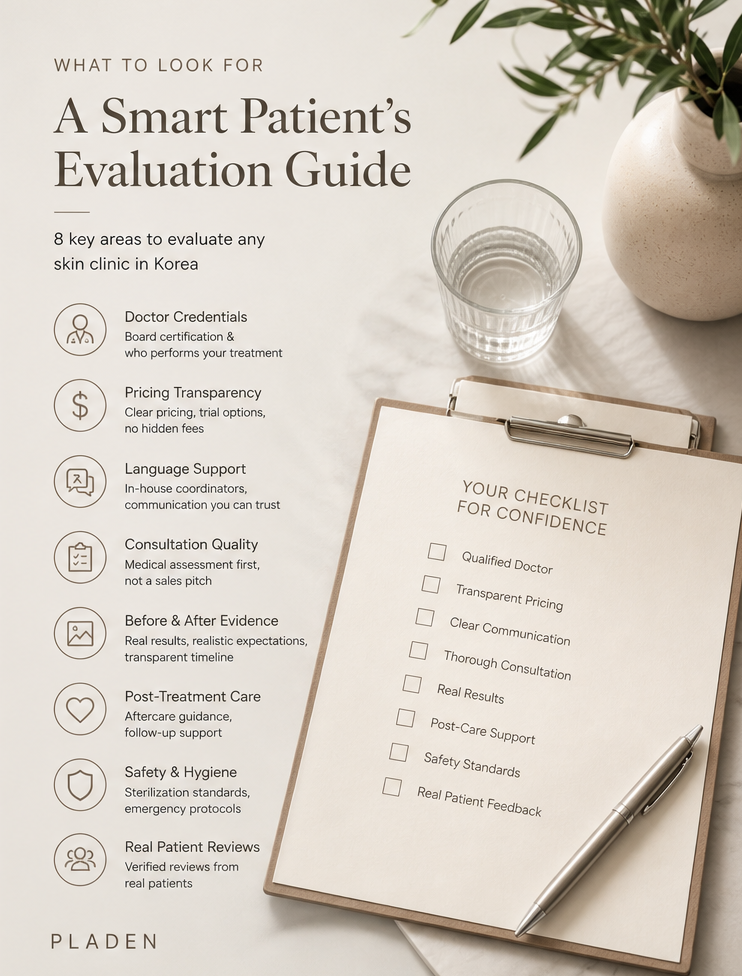
7. The Checklist: Use This Before Booking Any Korean Clinic
8. Conclusion
Choosing the right Korean skin clinic isn't about finding the cheapest price or the most Instagram followers. It's about finding a medical team that combines verified expertise, transparent pricing, clear communication, and genuine care for your outcome — before, during, and after treatment.
Use the checklist above as a practical tool. Ask the uncomfortable questions. Test the communication before you book. And remember: a clinic that's confident in its quality will welcome your scrutiny — not deflect it.
Frequently Asked Questions
*Disclaimer: This content is for informational purposes only. Always conduct your own due diligence when selecting a medical provider. The evaluation criteria in this article represent general best practices and do not guarantee outcomes at any specific clinic.