


If you've ever admired someone's perfectly straight, angular shoulder line — the kind that makes any top, dress, or blazer look effortlessly elegant — there's a good chance it's not entirely natural. Shoulder filler (also called "square shoulder" or "직각어깨" in Korean) has quietly become one of the most-requested aesthetic procedures in Korea, and it's starting to gain serious traction internationally.
Unlike most filler treatments that focus on the face, shoulder filler reshapes your entire upper body silhouette. It creates the straight, 90-degree shoulder line that's traditionally associated with model proportions — and it does it without surgery, without implants, and with zero downtime. Here's everything you need to know.
1. What Is Shoulder Filler?
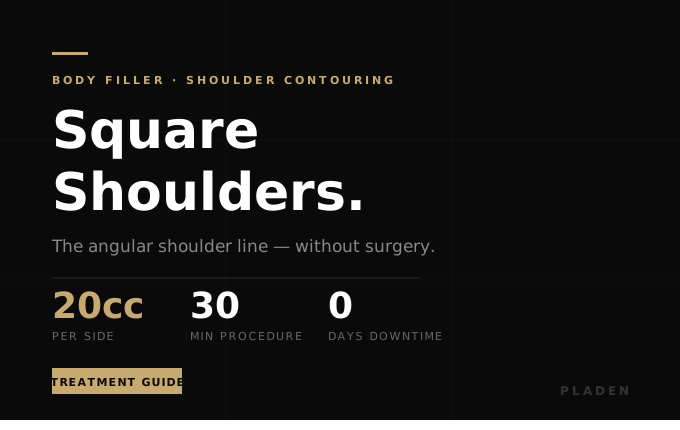
Shoulder filler involves injecting hyaluronic acid (HA) filler into the trapezius muscle area at the top of the shoulder, between the neck and the shoulder joint. The goal is to create a straighter, more horizontal shoulder line by filling in the natural slope where the neck meets the shoulder.
Most people have some degree of shoulder slope — the line from neck to shoulder tip curves downward. This is completely normal anatomy, but a more pronounced slope can make the neck appear shorter, the shoulders narrower, and the overall upper body silhouette less structured. Clothing hangs differently on sloped versus straight shoulders, which is why the fashion industry has always favored angular shoulder lines.
What It Changes
- Shoulder line angle — Transforms a sloping shoulder into a straighter, more horizontal line
- Neck appearance — The neck looks visually longer and more elegant when the shoulder line is straightened
- Upper body proportions — Creates broader-looking shoulders relative to the waist, enhancing the overall body silhouette
- Clothing fit — Off-shoulder tops, blazers, dresses, and formal wear all sit differently on angular shoulders
💡 Why Korea leads this trend: Shoulder filler originated in Korea and is still most commonly performed here. The procedure requires high-volume filler injection into a large muscle area — a technique that Korean practitioners have refined over thousands of cases. In most Western countries, this procedure is either unavailable or performed by very few specialists.
2. How the Procedure Works
The Consultation: Shoulder Line Design
Before any injection, the doctor assesses your natural shoulder anatomy — the degree of slope, the position of your trapezius muscle, your bone structure, and your aesthetic goals. Not every patient wants the same degree of angularity. Some want a dramatic 90-degree "square shoulder" effect; others prefer a subtle straightening that looks natural in everyday clothing.
The doctor marks the injection points and maps the volume distribution. This design phase is critical — shoulder filler is as much about architecture as it is about volume.
The Injection Process
The filler is injected into the upper trapezius region using a combination of needles and cannulas. The injection depth targets the space above the muscle fascia, where the filler creates a smooth, even layer that reshapes the shoulder contour.
The procedure takes approximately 15–30 minutes per side. Most patients require between 10–20cc of filler per side (20–40cc total) for a noticeable result. For dramatic transformations, some patients opt for up to 20cc per side.
Pain is manageable — the filler itself contains lidocaine, and topical numbing cream is applied beforehand. Most patients describe the sensation as pressure rather than sharp pain.
Immediate Results
Unlike many filler treatments that take days to settle, shoulder filler results are visible immediately. You walk out of the clinic with a different shoulder line. There may be mild swelling for 1–2 days, but the shape you see in the mirror post-treatment is very close to the final result.
3. Shoulder Filler at PLADEN: Options and Pricing
PLADEN offers shoulder filler across four different filler brands, each at a different price point. The choice depends on your budget, the volume needed, and how long you want results to last.
Which Filler Should You Choose?
Atiere is the most popular choice for shoulder filler at PLADEN — and across Korea generally. Because shoulder filler requires high volume (16–20cc), the cost difference between domestic and imported fillers multiplies significantly. Atiere delivers reliable results at a price point that makes the high-volume treatment accessible. It's the practical choice for most patients.
Rejuviel and Neuramis are mid-tier options with slightly different viscosity profiles. Some doctors prefer Rejuviel for its moldability in the shoulder area.
Juvederm is the premium imported option. It offers the longest duration but at roughly 3.5x the price per cc. For shoulder filler specifically, most patients find the cost-benefit favors domestic brands, since the treated area is large and the filler isn't visible the way facial filler is.
4. The Power Combo: Shoulder Filler + Trapezius Botox
Here's where the treatment gets really interesting. Many patients who want angular shoulders also have overdeveloped trapezius muscles — the large muscles that run from your neck to your shoulders. Bulky traps create a "mountain" shape that shortens the neck and makes the shoulder slope more pronounced.
Trapezius Botox (승모근 보톡스) relaxes and gradually slims these muscles. When combined with shoulder filler, the effect is dramatic:
- Botox reduces the muscle bulk that creates the slope
- Filler builds up the lateral shoulder to create the straight line
- Together, they produce a longer neck, straighter shoulders, and leaner upper body silhouette
PLADEN offers this as an integrated package: 20cc Atiere + Trapezius Botox (Newlux 100 units) for ₩1,980,000. For patients who also want to slim their upper arms, the full upper body package adds PT Arms PPOPKKI fat dissolving for ₩2,090,000 — addressing shoulders, traps, and arms in one session.
💡 The "Square Shoulder " package: Shoulder filler + trapezius Botox + arm fat dissolving = the most comprehensive non-surgical upper body reshaping available. It addresses structure (filler), muscle bulk (Botox), and localized fat (PPOPKKI) in a single visit. This combination is uniquely Korean — most countries don't offer all three in one clinic, let alone as a coordinated package.
5. How Long Does Shoulder Filler Last?
Shoulder filler longevity depends on the filler type and the volume injected:
- Domestic HA fillers (Atiere, Rejuviel, Neuramis) — Typically last 12–18 months in the shoulder area. The shoulder is a relatively low-movement zone compared to the face, which helps the filler maintain its shape longer.
- Juvederm — Can last 18–24 months due to its denser cross-linking.
Most patients schedule a touch-up at the 12-month mark. Because the body shape is already established from the first treatment, touch-ups typically require less volume (and therefore lower cost) than the initial session.
Is It Reversible?
Yes. Because shoulder filler uses hyaluronic acid, it can be dissolved with hyaluronidase (필러 녹이는 주사) if needed. This is extremely rare — most patients are happy with the result — but the option exists. PLADEN offers hyaluronidase at ₩90,000 per session.
6. Who Is the Ideal Candidate?
Shoulder filler works best for patients who:
- Have sloped or narrow shoulders and want a straighter, more angular line
- Want their neck to appear longer and more elegant
- Want better clothing fit — especially off-shoulder tops, blazers, and formal wear
- Are preparing for a specific event — weddings, photoshoots, body profile shoots
- Want non-surgical body reshaping with immediate results and zero downtime
Who Should Consider Alternatives
- Patients who are significantly overweight in the upper body — fat reduction should come first
- Patients with extremely thin tissue over the shoulder area — very low body fat can make filler feel or look unnatural in some cases
- Patients who expect the result to be permanent — HA fillers require maintenance
7. Recovery and Side Effects
One of the biggest advantages of shoulder filler is the virtually zero downtime:
- Day 0 — Results visible immediately. Mild soreness at injection sites. You can return to normal activities.
- Days 1–3 — Minor swelling and possible bruising at injection points. Avoid heavy lifting or intense upper body exercise.
- Day 7 — Swelling fully resolved. Final shape settled. Resume all activities including exercise.
Side effects are minimal: temporary soreness, mild bruising, and occasional swelling. Serious complications are extremely rare when performed by an experienced practitioner using proper technique and certified filler products.
8. Shoulder Filler for International Patients
Shoulder filler is one of the most "travel-friendly" aesthetic procedures available. The treatment takes 30–60 minutes, results are immediate, and there's no recovery period that would disrupt your trip. You can get the treatment on a Monday and go sightseeing on Tuesday.
For international patients visiting PLADEN, the clinic provides:
- English-speaking coordinators who manage your entire visit
- Transparent pricing — the package prices listed above are fixed, with no hidden fees
- Combination scheduling — shoulder filler can be combined with other treatments (Botox, skin boosters, fat dissolving) in the same visit to maximize your time in Seoul
- Post-treatment follow-up via messaging for any questions after you return home
Frequently Asked Questions
*Disclaimer: This content is for informational purposes only and does not constitute medical advice. Individual results may vary based on anatomy, filler type, and treatment design. Side effects may include temporary swelling, bruising, and soreness. Consult with a qualified medical professional before undergoing any procedure.