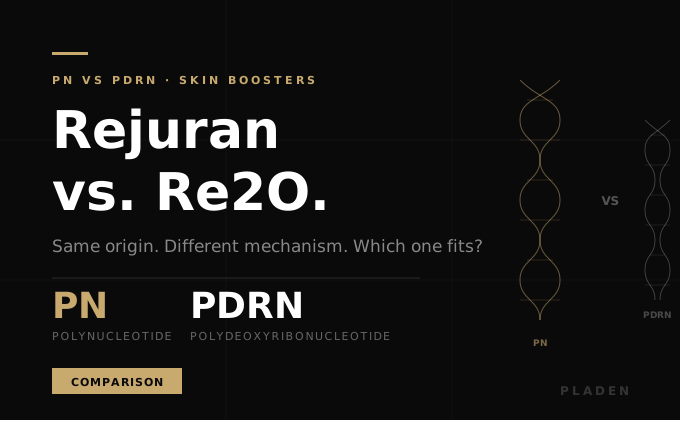
If you've been researching skin rejuvenation treatments in Korea, two names come up constantly: Rejuran and Re2O. Both are injectable skin boosters. Both promise regeneration. Both involve polynucleotide-derived compounds. So what's actually different?
The confusion is understandable — even some clinics use them interchangeably. But they are not the same treatment. They use different active compounds, work through different biological mechanisms, and are better suited for different skin conditions. This guide explains exactly how.
The Basics: What They Share
Before diving into the differences, it helps to understand what Rejuran and Re2O have in common — because the overlap is what causes most of the confusion.
- Both are injectable skin boosters — delivered via micro-injections across the face
- Both are derived from DNA fragments (specifically, from salmon DNA)
- Both aim to regenerate skin at the dermal level, not just hydrate the surface
- Both require multiple sessions (typically 3–4) for full results
- Both are widely available across Korean dermatology and aesthetic clinics
This is where the similarities end. The critical difference is in the type of DNA fragment each product uses — and that difference changes how they interact with your skin cells.
Rejuran: Polynucleotide (PN) Therapy
Rejuran Healer uses PN (polynucleotides) — relatively large-chain DNA fragments with a molecular weight typically above 1,000 kDa. These long-chain molecules work primarily by stimulating your fibroblasts (the cells that produce collagen and elastin) through a wound-healing signaling pathway.
How PN Works in Your Skin
When polynucleotide fragments are injected into the dermis, your fibroblasts interpret them as repair signals. The cells respond by ramping up production of:
- Type I and Type III collagen — the structural proteins that give skin its firmness and elasticity
- Elastin — the protein responsible for skin's ability to "bounce back"
- Glycosaminoglycans (GAGs) — molecules that retain moisture in the dermis
The mechanism is essentially this: PN fragments trick your skin into thinking it needs to repair itself, which triggers a cascade of regenerative activity — without any actual tissue damage.
What Rejuran Does Best
- Improves overall skin elasticity and firmness
- Reduces fine lines (especially around the eyes and mouth)
- Restores "bounce" to thin, dehydrated skin
- Improves skin texture and pore appearance over time
- Enhances natural radiance — the "glass skin" effect
💡 The Rejuran family: Rejuran isn't a single product. Rejuran Healer is the standard full-face formula. Rejuran S is higher-concentration for scars. Rejuran I is a thinner formula for the under-eye area. Rejuran HB adds hyaluronic acid for extra hydration. Same PN technology, different concentrations and viscosities for different treatment zones.
Re2O: Polydeoxyribonucleotide (PDRN) Therapy
Re2O uses PDRN (polydeoxyribonucleotide) — shorter-chain DNA fragments with a lower molecular weight, typically between 50–1,500 kDa. While closely related to PN, PDRN activates a fundamentally different biological pathway.
How PDRN Works in Your Skin
The key difference is that PDRN specifically activates the A2A adenosine receptor — a receptor involved in your body's anti-inflammatory and tissue repair response. When this receptor is activated, several things happen simultaneously:
- Inflammation decreases — the A2A pathway actively suppresses pro-inflammatory cytokines
- Angiogenesis increases — new blood vessel formation improves nutrient delivery to the skin
- Cell proliferation accelerates — fibroblasts and keratinocytes divide faster
- Collagen synthesis increases — similar to PN, but through a different signaling cascade
In simple terms: Rejuran (PN) tells your skin to build more. Re2O (PDRN) tells your skin to calm down and repair. Both produce regeneration, but through different doors.
The Full Comparison
Which One Should You Choose?
The honest answer: it depends entirely on what your skin needs right now. Here's a practical decision framework:
Choose Rejuran If:
- Your primary concern is aging — fine lines, loss of firmness, thinning skin
- Your skin is generally healthy but has lost its "bounce" and glow
- You want the most established, extensively studied option with the longest track record in Korea
- You're looking for overall skin quality improvement rather than targeting a specific condition
Choose Re2O If:
- Your skin is chronically inflamed, red, or reactive
- You have rosacea or redness-prone skin that flares with most treatments
- You recently had a laser procedure and want to accelerate healing
- Your skin barrier is compromised — it stings with basic products, stays dry no matter what you apply
- You need regeneration but your skin can't handle the inflammation that comes with stronger treatments
Consider Both If:
- You want comprehensive rejuvenation — structural collagen rebuilding (Rejuran) + calming and barrier repair (Re2O)
- You're doing a multi-session program — some clinics alternate Rejuran and Re2O across sessions for layered benefits
- Your skin has multiple issues — aging + sensitivity, or scarring + inflammation
💡 Clinical reality: Many experienced Korean dermatologists don't see Rejuran and Re2O as competing options. They see them as complementary tools in a toolkit — each suited for a different skin state. The best clinics customize the protocol based on what your skin needs at each session, sometimes switching between the two as your skin condition evolves.
The Shared Problem: Pain Compliance
Whether you choose Rejuran or Re2O, both treatments share the same practical challenge: they require dozens of micro-injections across the face, and they both require 3–4 sessions for full results.
This is where theory meets reality. The biological mechanism of the booster matters — but so does whether you can actually sit through the full treatment course. A significant number of patients abandon their skin booster program after 1–2 sessions because of injection discomfort. And an incomplete course means incomplete results, regardless of how advanced the formula is.
This is a clinical problem, not a product problem. The same Rejuran or Re2O formula produces dramatically different outcomes depending on whether the patient completes three sessions or just one.
At PLADEN, this is treated as a core clinical priority. PLADEN's painless Rejuran and Re2O protocols combine advanced numbing techniques with refined injection methods specifically designed to minimize discomfort throughout the session. The approach isn't about rushing through injections — it's about making each session comfortable enough that patients actually complete the full course and see the results the treatment is designed to deliver.
Conclusion
Rejuran and Re2O are both powerful skin regeneration treatments, but they are not interchangeable. Rejuran (PN) excels at stimulating collagen production and restoring skin elasticity — it's the go-to for anti-aging and overall skin quality improvement. Re2O (PDRN) excels at calming inflammation while regenerating — it's the better choice for sensitive, reactive, or compromised skin.
The best choice depends on your skin's current condition, not on which product is "newer" or "more popular." And whichever you choose, two factors matter more than the formula itself: the physician's ability to design the right protocol for your skin, and whether the clinic's injection technique allows you to comfortably complete the full treatment course.
Individual results vary based on skin type, condition severity, and treatment protocol. Consult a board-certified dermatologist for a personalized assessment.